










Policy Corner Brief: FEBRUARY 2026
CSF’S TAYLOR SCHMITZ TO REPRESENT SPORTING COMMUNITY BEFORE CONGRESS ON EXPLORE ACT
Article Contact: Taylor Schmitz
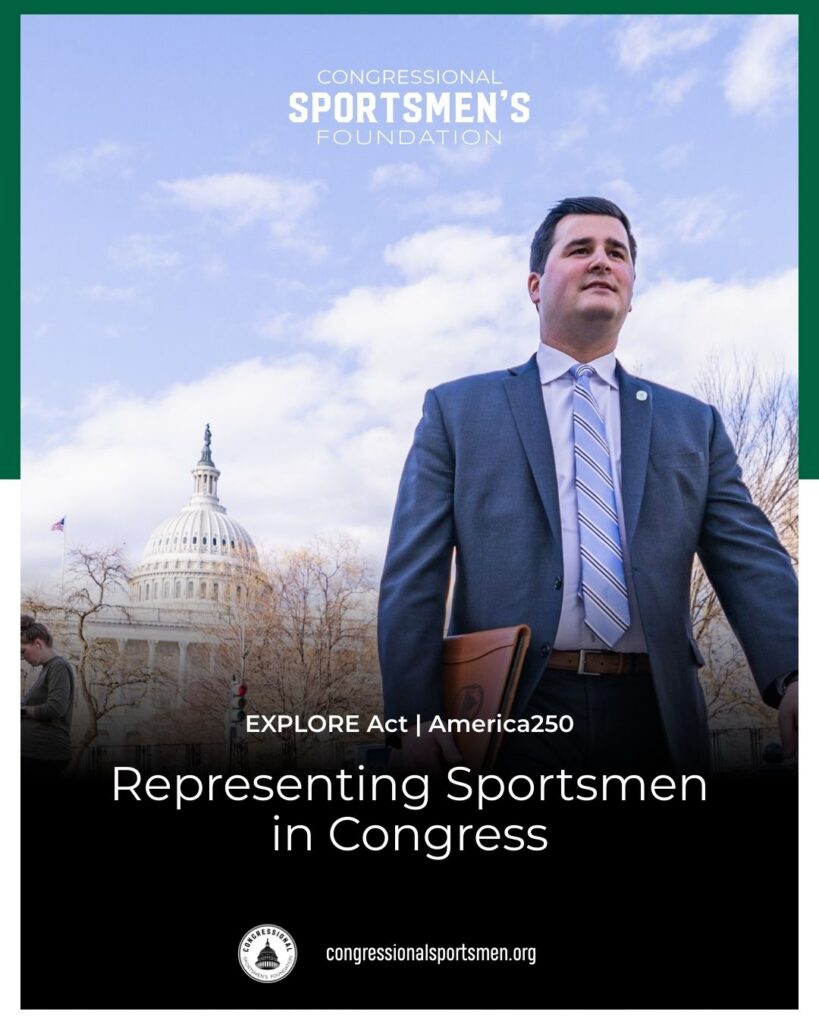 Why It Matters: The EXPLORE Act represents one of the most comprehensive outdoor recreation bills to become law and includes a number of longstanding priorities for the Congressional Sportsmen’s Foundation (CSF). Taylor Schmitz, CSF’s Senior Vice President, will be the sole representative from the sporting-conservation community to talk about the importance of fully implementing this law to improve access for sportsmen and women and conservation of our natural resources.
Highlights:
- At 10:15 a.m. Eastern on Wednesday, January 21, CSF’s Senior Vice President, Taylor Schmitz, will testify before the House Natural Resources Subcommittee on Federal Lands on the landmark EXPLORE Act, where he will be the sole witness from the sporting community.
- The EXPLORE Act, which became law in January 2025, was led in Congress by Congressional Sportsmen’s Caucus (CSC) Co-Chair Representative Bruce Westerman in the House, and former CSC Co-Chair and current CSF Board Member Senator Joe Manchin, who led the Senate companion bill (as well as the dozens of other CSC Members who worked to see this bill become law).
The EXPLORE Act is a robust package that contains many important provisions to increase access for sportsmen and women. One of the most impactful provisions is language that will bolster recreational shooting opportunities by requiring the U.S. Forest Service (USFS) and the Bureau of Land Management (BLM) to have a minimum of one target shooting range free to the public in each of their respective districts. At a time when safe and accessible places to target shoot are increasingly more difficult to find, this provision is critical to enhance our recreational shooting traditions.
Additionally, the EXPLORE Act contains an important provision to improve forest health through collaboration – the Good Neighbor Authority for Recreation (GNA). This provision provides authority that allows USFS and BLM to authorize states, counties, and tribes to assist the USFS and BLM in meeting land management goals. Specifically, the EXPLORE Act allows for GNA projects to occur on non-federal land and allows non-federal partners to retain the revenue generated from forest management projects on federal lands. The GNA language in the EXPLORE Act also includes language to allow the use of funds generated through restoration projects for recreation purposes, such as building shooting ranges, fishing piers, docks, boat landings, and other recreation facilities.
The EXPLORE Act will also aid federal agencies in their efforts to prevent the spread of aquatic invasive species, which pose a serious threat to native aquatic ecosystems and the economy. Once established, aquatic invasive species are difficult, if not impossible, to eradicate, and significant resources must be invested annually in population management. Preventing harmful introductions of aquatic invasive species before they occur is the most effective means to avoid the risk they present.
Be sure to tune in at 10:15 a.m. Eastern to see CSF represent the sporting community on the EXPLORE Act.
SECRETARY BURGUM ISSUES IMPORTANT ORDER TO INCREASE ACCESS FOR HUNTERS AND ANGLERS
(January 14, 2026) – Washington, D.C. — Yesterday, Secretary of the Interior Doug Burgum issued Secretarial Order 3447 (S.O. 3447), Expanding Hunting and Fishing Access, Removing Unnecessary Barriers, and Ensuring Consistency Across the Department of the Interior (DOI) Lands and Waters, a move strongly supported by the Congressional Sportsmen’s Foundation (CSF).
S.O. 3447 demonstrates the commitment of Secretary Burgum to our nation’s hunters and anglers by directing bureaus and offices within the DOI’s purview to prioritize access, remove unnecessary barriers, improve coordination and alignment with state, tribal, and territorial wildlife agencies, and elevating any proposed reductions in hunting and fishing access to the appropriate leaders within DOI. CSF is excited to see directives to work to improve access for sportsmen and women provided to the U.S. Fish and Wildlife Service, the Bureau of Land Management, National Park Service, and the Bureau of Reclamation to improve Departmental-wide access for hunting and fishing. This Secretarial Order also builds on President Trump’s Executive Order entitled Make America Beautiful Again, which recognizes the important role hunters and anglers play.
“CSF extends our appreciation to Secretary Burgum for his leadership and support for America’s hunters and anglers. As America enters its 250th Anniversary, it is important to recognize that our country provides an unmatched opportunity for the public, regardless of income or background, to enjoy our time-honored traditions of hunting and fishing, something that is unique to the rest of the world,”said CSF President and CEO Jeff Crane. “Secretarial Order 3447 recognizes our hunting and fishing traditions, and we stand ready to work with the Secretary to implement this directive.”
Further, S.O. 3447 recognizes that science should drive any decisions related to the use of lead ammunition and fishing tackle. Specifically, this Secretarial Order requires that lead ammo and tackle may not be restricted within the Refuge System unless site-specific and species-specific scientific evidence demonstrates a direct population-level impact while requiring the alignment of regulations to be consistent with state and tribal regulations. Notably, S.O. 3447 recognizes the importance of allowing hunters and anglers to make their own determination as to what type of ammunition or tackle they prefer by continuing the implementation of voluntary lead-free incentive programs.
S.O. 3447 is an important step forward for sportsmen and women, and we are looking forward to working closely with the Department of the Interior to ensure public lands are open to hunting and fishing where it matters.
EARLY LEGISLATIVE ACTION SIGNALS A BUSY YEAR FOR SPORTSMEN IN THE GREAT PLAINS
Article Contact: Jake Gould
Why It Matters: The 2026 legislative session is off to a hot start in the Great Plains, with legislation impacting sportsmen and women already on the move. Some states have CSF priority legislation that is carried over from the 2025 legislative session in addition to new legislation that was introduced in 2026.
Highlights:
- Iowa Senate Joint Resolution 7 (SJR 7) is a proposed constitutional amendment for the Right to Hunt and Fish to be included in the Iowa Constitution.
- Iowa House File 536 (HF 536) would create a firearm, hunting, and wildlife curriculum for students in sixth through eighth grade – a policy priority for The Congressional Sportsmen’s Foundation (CSF).
- South Dakota House Bill 1037 (HB 1037) would provide a free fishing license for resident active duty and veterans of the United States armed forces.
- This session, CSF will continue to track and engage on legislation that stands to impact sportsmen and women.
The legislative sessions in the Great Plains are in full swing with states wasting no time on introducing legislation that impacts sportsmen and women. Additionally, a few states have bills that are eligible to be carried over from the 2025 legislative session.
Last session, Iowa introduced Senate Joint Resolution 7, which would enshrine the Right to Hunt and Fish in Iowa’s Constitution. SJR 7 was initially approved by the Senate Natural Resources and Environment Committee but was then unfavorably amended, and CSF is actively engaged with partners and legislators to ensure that the language is remedied.
Also introduced last year in Iowa, House File 536 would create a firearm, hunting, and wildlife curriculum that may be implemented by school districts as an elective for students enrolled in sixth through eighth grade. Last session, HF 536 passed the House Education subcommittee, and will be a priority for CSF to get it to the finish line in 2026.
This year, South Dakota introduced House Bill 1037, which would provide active duty and veterans of the United States military a free fishing license. While CSF appreciates opportunities to show support for those who serve our nation as members of the armed forces, there are considerations associated with waiving license requirements to account for lost conservation funding that South Dakota Game, Fish, and Parks (GFP) relies on for their conservation efforts in the Mount Rushmore State. CSF maintains that legislators should also include language to ensure that GFP is reimbursed for the funds lost to free or discounted licenses.
The Congressional Sportsmen’s Foundation is committed to working with legislators across the country, including the Great Plains, to promote policies that benefit hunters, anglers, recreational shooters, and trappers, and will continue to do so during this new legislative session.
BILL TO UNNECESSARILY LIMIT OPPORTUNITIES FOR SPORTSMEN AND WOMEN INTRODUCED IN MISSISSIPPI
Article Contact: Mark Lance

Why It Matters: Limiting access to Mississippi’s sportsmen and women through blanket bans on equipment, requiring individuals to have access to 2k contiguous acres of privately owned ground to hunt with, train, or utilize any hunting dog, and requiring people to obtain a depredation permit from the state to eliminate any nuisance animal is entirely unnecessary and counterintuitive to science-based wildlife management.
Highlights:
- On January 16th, HB 828 was introduced by Representative Justin Keen and aims to outlaw the use of thermal optics, suppressors, and night vision; limit the use of hunting dogs on private property and completely eliminate it on public lands; require Mississippians to obtain a depredation permit to be able to remove any nuisance animal; and more.
- HB 828 has been referred to the House Committee on Wildlife, Fisheries, and Parks (Committee) where it awaits a scheduled hearing.
- On January 20th, the Congressional Sportsmen’s Foundation (CSF) submitted a testimony in opposition to HB 828 to the full Committee.
Hunting with dogs is a traditional pastime that’s been passed down for generations of Mississippians. Blanket bans such as those being proposed on hunting dogs, in addition to the limits on equipment that people can utilize to manage or eliminate nuisance animals as well as being required to obtain a depredation permit is added government bureaucracy.
HB 828 directly threatens the tradition of hunting with dogs by ambiguously requiring that hunting with dogs is only allowed on private property that is comprised of a minimum of 2,000 contiguous acres. Specifically, it does not stipulate exactly what kind of hunting dogs that would be regulated or the game in which those dogs are pursuing. There is also no carve-out for dogs being used to track and recover downed game animals. All in all, this bill is a direct threat to the very fabric of the rich hunting traditions that so many Mississippians share each year.
Ironically, HB 828 has been dubbed the “Fair Chase Act,” yet the bill really does nothing to positively impact fair chase. Limiting the use of thermals, suppressors, and night vision does nothing but benefit nuisance animals. It’s already illegal to hunt deer at night, and the poachers who are doing so now will continue to do so if this legislation were to pass. This would only impact the individuals who operate appropriately and who are doing their part to manage nuisance species.
CSF’s letter stated: “In addition to the threats to hunting with dogs, HB 828 further impacts Mississippi’s hunters, farmers, and private landowners by limiting the use of suppressors, thermal optics, and night vision to eliminate nuisance animals at night. Thermal optics and suppressors are just two of many tools in the bag in the effort to manage feral hogs, coyotes, and more. Feral hogs alone cause $2.5 billion in damage every year in the United States, and their population continues to grow in Mississippi. Therefore, hunters and private landowners should be offered the opportunity to continue to be able to take those animals with the effective tools currently allowed under state law.”
The Congressional Sportsmen’s Foundation (CSF) will continue to work with the Mississippi Legislative Sportsmen’s Caucus, the Mississippi Department of Wildlife, Fisheries, and Parks, and our partners to defend access for sportsmen and women and oppose HB 828.
CSF PRIORITY HUNTER EDUCATION IN SCHOOLS LEGISLATION INTRODUCED IN TENNESSEE
Article Contact: Conner Barker
Why It Matters: Today’s youth are the next generation tasked with carrying our time-honored traditions forward. Introducing them to the outdoors helps build the foundation needed to sustain those traditions into the future. Hunter safety education in schools programs play a key role in this effort by instilling a strong conservation ethic, teaching essential hunting safety skills, and encouraging youth to support the “user pays – public benefits” structure that is the American System of Conservation Funding through the purchase of sporting licenses.
Highlights:
- On February 2, Senate Bill 2369 (SB 2369) was introduced by Tennessee Legislative Sportsmen’s Caucus (Caucus) Co-Chair Senator Paul Rose. SB 2369 was followed by the House companion bill introduced on February 4, House Bill 2588 (HB 2588), which is sponsored by Caucus Co-Chair Representative Jesse Chism.
- SB 2369 and HB 2588 would allow schools to offer students in grades 5–12 a hunter education course as part of the student’s physical education, health, or safety instruction curriculum.
- Both bills are currently awaiting committee assignments.
Hunters and many other conservationists across the nation are continually developing new methods to promote hunter recruitment, retention, and reactivation (R3) efforts. What better way to recruit new hunters than bringing these efforts into local school districts?
In what seems to be an increasingly digitized world, less screen time and more time spent outside is generally always welcome and encouraged by both parents and school administrators. SB 2369/HB 2588 would allow students to receive school credit and complete the mandatory hunter safety education curriculum required of all hunters to head afield. This curriculum would be offered as part of a student’s physical education, health, or safety instruction curriculum in grades 5 – 12.
Not only do students check two boxes at one time by opting to take an in-school hunter safety education course, but they also receive safety training that is an essential tool required of all hunters. Additionally, by recruiting new hunters at a young age and encouraging them to continue our hunting traditions into adulthood, they would eventually contribute to the “user pays – public benefits” structure that is the American System of Conservation Funding (ASCF) through the purchase of hunting licenses. Building the foundational knowledge needed to understand the basics of hunting ethics and conservation is critical to ensuring the next generation of sportsmen and women and the sustained future of the ASCF.
The Congressional Sportsmen’s Foundation (CSF) commends Caucus leaders for taking the initiative to introduce this important piece of legislation in the Volunteer State, and we look forward to working with the Caucus and our partners to advance this initiative.
CSF PRIORITY HUNTER EDUCATION IN SCHOOLS BILL HEADS TO GOVERNOR’S DESK IN GEORGIA
Article Contact: Conner Barker
Why It Matters: Today’s youth will soon be shouldered with carrying our time-honored traditions into the next generation. This also includes being the primary funders of conservation through the “user pays – public benefits” structure that is the American System of Conservation Funding. Being proactive and creative in recruiting and retaining the next generation of sportsmen and women is critical in ensuring our hunting traditions are sustained well into the future.
Highlights:
- In February 2025, Georgia Legislative Sportsmen’s Caucus (Caucus) Co-Chairs Representatives Chas Cannon and Matt Dubnik, among other Caucus members, introduced House Bill 451, which would allow public schools to offer hunter safety education courses in grades six through twelve.
- On the last day of the 2025 legislative session, the hunter safety education course language from HB 451 was included in Senate Bill 148 (SB 148) but fell short of the Sine Die deadline in the Georgia State Senate.
- On January 28, SB 148 received a unanimous agreement vote to the House changes from 2025 and now heads to Governor Sportsmen’s Caucus (GSC) member Governor Brian Kemp’s desk for his signature.
Georgia, like many other southeastern states, is overall a very rural state that offers plenty of opportunities for young people to learn new outdoor skills and hobbies like hunting. Like any new endeavor, proper guidance, including critical safety instruction, is paramount before heading afield.
SB 148/HB 451 requires the State Board of Education to develop content standards for instruction in hunting safety education, which would give school boards the option to establish a hunting safety curriculum for the next school year. The course will be based on current hunting safety education courses offered by the Georgia Department of Natural Resources (DNR). Additionally, the course will be taught by an individual who is certified by the DNR as a hunter education instructor.
From the rural north Georgia mountains to metro Atlanta to the lower coastal plains, students across the state will have the opportunity to satisfy their required hunter safety education requirement while simultaneously earning classroom credit. The course will provide students with information needed to understand the purpose of hunting, general hunting practices, conservation ethics shared by all sportsmen and women, all while gaining a more complete understanding and appreciation for all wildlife in Georgia.. Students will also learn that they are next in line as the primary funders of wildlife conservation through the purchase of sporting licenses.
The Congressional Sportsmen’s Foundation (CSF) greatly appreciates the work of Caucus Co-Chairs Representatives Chas Cannon and Matt Dubnik in both the 2025 and 2026 legislative sessions to see this priority through the legislative process. CSF looks forward to working with Governor Kemp to sign SB 148 into law in the coming months.
SHORTSIGHTED BILL TO ELIMINATE INDIANA NATURAL RESOURCES COMMISSION PASSES HOUSE
Article Contact: Bob Matthews
Why It Matters: Natural Resources Commissions throughout the country provide a dedicated forum for hunters, anglers, and trappers to voice their opinions to an appointed body that is specifically comprised of individuals that are knowledgeable about sporting-conservation issues. In many cases, such as Indiana, the Commission also serves as the regulatory entity charged with working with the Department to adopt science-based regulations on hunting, fishing, and trapping, among other fish and wildlife management decisions.
Highlights:
- Indiana House Bill 1003 passed out of its originating chamber (67-29) and now heads to the Indiana Senate.
- The bill stands to remove a wide range of government boards and commissions and includes the Indiana Natural Resources Commission (NRC).
- Removing the NRC would eliminate a well-informed decision-making body as well as the dedicated forum that sportsmen and women rely on to voice their opinion on key conservation issues.
- The Congressional Sportsmen’s Foundation (CSF) advocated against the bill’s passage and will continue to do so as the bill is heard in the Senate.
Last week, the Indiana House of Representatives passed HB 1003, which seeks to eliminate or consolidate more than sixty boards and commissions in the Hoosier State. This includes the Indiana Natural Resources Commission, which was established in the 1960s alongside the Department of Natural Resources and serves as the rulemaking authority. Without a clear path forward for replacing the rulemaking process, fish and wildlife regulations stand to lag behind what is needed for sound, science-based management.
Regularly scheduled NRC meetings provide Hoosier hunters, anglers, and trappers a dedicated forum to discuss and provide input on fish and wildlife management decisions. Given that sportsmen and women are the primary funders of fish and wildlife conservation efforts through license purchases and the revenue generated by purchases of firearms, ammunition, fishing rods, tackle, and other sporting goods, their voice holds the utmost value in conservation decision-making. Eliminating the NRC also eliminates the ability of sportsmen and women to participate in the decision-making process concerning the traditions that they directly fund and support.
CSF delivered a letter to each member of the Indiana House of Representatives urging that the NRC’s elimination be removed from the bill. As HB 1003 moves to the Senate, CSF will continue to work with national and in-state partners to express the importance of the Indiana Natural Resources Commission and its impact on protecting our time-honored outdoor traditions.
SPORTSMEN-FOCUSED LEGISLATION TAKES SHAPE IN EARLY 2026 ARIZONA SESSION
Article Contact: Kaylee Mortensen
Why It Matters: The 2026 Arizona Legislative Session is already off to a strong start, with several proposed bills that are relevant to sportsmen and women across the state. This includes complimentary licenses for veterans which would impact conservation funding in Arizona and membership requirements for the Arizona Game and Fish Commission, which could potentially restrict access and opportunity for sportsmen and women.
Highlights:
- Arizona Senate Bill 1155, currently assigned to the Senate Rules Committee, the Senate Government Institutions Committee, and the Senate ATT Committee proposes changes to complimentary and reduced-fee licenses for veterans with service-connected disabilities.
- Arizona House Bill 2162, also in Committee, would require that at least one member of the Arizona Game and Fish Commission be a cattleman or rancher.
- Early engagement is critical as the legislative session gains momentum, and the Congressional Sportsmen Foundation (CSF) is working closely with the Arizona Legislators for Wildlife Caucus and the Arizona Game and Fish Department (AZGFD) to ensure that the voices of sportsmen and women are represented at the Capitol.
The 2026 Arizona Legislative Session convened on January 12, 2026. The session is already well underway, with legislation introduced that impacts sportsmen. As of February 2nd, all Senate bills have been introduced, with the House bill introduction deadline set for February 9th. CSF will remain engaged throughout the session and provide ongoing updates on legislation impacting sportsmen and women.
Under current law, veterans must have a 100 percent service-connected disability to qualify for a free license, and those with a service-connected disability can receive a reduced fee license. Senate Bill 1155 would alter the law so that any veteran with a service-connected disability would be able to receive a complimentary license. While providing free licenses to veterans with disabilities can be a meaningful way for Arizona to honor those who have served, CSF recognizes that hunting and fishing license revenue plays a critical role in funding wildlife conservation. Any expansion of complimentary licenses should be coordinated with AZGFD to ensure the agency is reimbursed for lost revenue to support conservation efforts.
In addition to legislation affecting license fees, lawmakers are also considering changes to the structure of Arizona’s wildlife governance. House Bill 2162 would require that at least one member of the Arizona Game and Fish Commission be a cattleman or rancher. This bill is controversial because it guarantees a board seat for one industry, without providing similar assurances for hunters, anglers, and trappers. CSF views it as imperative that sportsmen and women are on fish and game commissions, so that they may advance and protect the time-honored traditions that define America’s sporting heritage.
The Congressional Sportsmen’s Foundation will continue to monitor SB 1155, HB 2162, and other legislation throughout Arizona’s 2026 legislative session. CSF will keep championing the interests of sportsmen and women in partnership with the Arizona Legislators for Wildlife Caucus, AZGFD, and our in-state partners to ensure their voices are represented in Arizona.
CSF PRIORITY LEGISLATION ON THE MOVE IN MISSISSIPPI
Article Contact: Mark Lance
 Why It Matters: The sale of hunting and fishing licenses makes up the bedrock of conservation funding in the United States. While efforts to provide certain groups of well-deserving individuals with a financial break on license fees are commendable, it threatens funding that benefits resources held in the public trust. Additionally, science-based wildlife management depends on reliable data to determine harvestable surpluses. Mandatory hunter harvested deer reporting provides the Mississippi Department of Wildlife, Fisheries, and Parks (MDWFP) with accurate data on deer populations across all 82 counties.
Highlights:
- On January 15, HB 710 was introduced by NASC Executive Council Member and Mississippi Legislative Sportsmen’s Caucus (Caucus) Co-Chair Representative Scott Bounds and requires that MDWFP be reimbursed for any lost revenue resulting from the issuance of free or discounted hunting and fishing licenses, admission to state parks, and other fees through the State General Fund.
- HB 710 cruised through both committee stops in the House and passed the House of Representatives unanimously (119-0) on February 12 The Congressional Sportsmen’s Foundation (CSF) led the charge in having the legislation introduced and provided testimony.
- Additionally, on February 12, HB 1361, which was authored by Caucus Member Representative Bill Kinkade and aims to establish a mandatory game check program for white-tailed deer, passed the House of Representatives 62-44. CSF submitted a letter in support of HB 1361 as well.
Hunting, fishing, recreational shooting, and trapping make up so much of the cultural and economic fabric of the Magnolia State, and the abundant opportunities for sportsmen and women attract folks from all over the country to come and experience all that Mississippi has to offer. The Mississippi Legislative Sportsmen’s Caucus recognizes the importance of our shared outdoor heritage and remains in the fight to ensure the future of these activities for generations to come.
MDWFP is tasked with conserving and enhancing Mississippi’s wildlife, fisheries, and parks, providing quality outdoor recreation, and engaging the public in natural resource conservation. HB 710 and HB 1361 would help ensure that MDWFP continues to receive the necessary funding and data to continue to work towards accomplishing its mission.
Every year bills are introduced that would allow individuals to purchase a free or heavily discounted hunting and/or fishing license. In these efforts, legislators tend to target deserving groups; however, if passed, these bills could have a significant impact on conservation funding for their respective state’s fish and wildlife agency. That is where legislation that reimburses the state fish and wildlife agency for revenue lost due to the passage and creation of free and discounted hunting licenses comes into play to protect conservation funding, which is a top priority for the Congressional Sportsmen’s Foundation (CSF) across the country. HB 710 is not retroactive, which means that all free and discounted hunting and fishing licenses that are in effect before July 1, 2026, would not be impacted.
CSF has also supported efforts to bring Mississippi alongside the other 49 states in the country and establish a game check program for hunter harvested white-tailed deer so that MDWFP has accurate, real-time data on deer populations across the state. One of the key tenets of the North American Model of Wildlife Conservation is science-based decision-making. If MDWFP does not know how many deer are being taken by hunters each deer season, how can we expect them to effectively set bag limits, seasons, etc.?
Finally, a bill CSF reported on earlier in the session, HB 828, which aimed to outlaw the use of thermal optics, suppressors, and night vision limit the use of hunting dogs; require Mississippians to obtain a depredation permit to be able to remove any nuisance animal; and more, died in the House Wildlife, Fisheries, and Parks Committee after intense public opposition and input from CSF.
CSF would like to thank Representative Bounds and Representative Kinkade for their leadership in advancing both HB 710 and HB 1361, and we will continue to support both efforts as they head to the Senate.
HOUSE AGRICULTURE LEADERSHIP RELEASES FIRST DRAFT OF 2026 FARM BILL
Article Contact: Kent Keene, John Culclasure
 Why It Matters: Generally reauthorized every five years, the last full iteration of the Farm Bill expired in late-2023. Representing one of the largest and most important pieces of legislation passed by Congress, the Farm Bill covers topics ranging from crop insurance to the Supplemental Nutrition Assistance Program (formerly known as Food Stamps). The Farm Bill’s provisions touch nearly all Americans in one way or another. For sportsmen and women, our nation’s original conservationists, the Farm Bill’s Conservation and Forestry Titles represent some of the greatest investments in fish, wildlife, and forest conservation in the world. Friday’s announcement regarding the 2026 Farm Bill represents a positive step toward the full reauthorization of this important legislation.
Highlights
- On Friday, February 13th, House Agriculture Committee Chairman G.T. Thompson (PA) released draft text of the 2026 Farm Bill, a critical starting point as Congress looks to fully reauthorize the legislation for the first time since 2023.
- Last year, many of the Congressional Sportsmen’s Foundation’s (CSF) priorities were incorporated into the Farm Bill’s baseline through the One Big Beautiful Bill, but CSF remains engaged in hopes of advancing more priorities important to sportsmen and women.
- In addition to numerous existing programs that are already critical for sportsmen and women, the Farm Bill draft released Friday included the creation of the Forest Conservation Easement Program, a top priority for CSF and many partners in the sporting-conservation community.
Last Friday, House Agriculture Committee Chairman and Congressional Sportsmen’s Caucus Member Congressman G.T. Thompson announced The Farm, Food, and National Security Act of 2026, his version of the 2026 Farm Bill. Since last expiring in 2023, the Farm Bill has existed in the form of single-year continuations with changes incorporated through the Inflation Reduction Act and the One Big Beautiful Bill. However, Friday’s announcement represents an important step toward the full reauthorization of this critical piece of legislation.
While both the Inflation Reduction Act and the One Big Beautiful Bill saw significant investments in the Farm Bill’s Conservation Title that accomplished many priorities set by CSF and our partners within the community, the full reauthorization of the bill is critical for the continued success of many programs. Chief among these is the original Conservation Reserve Program (CRP) that served as the foundation for today’s Conservation Title. As currently written, the 2026 Farm Bill would reauthorize CRP while maintaining the program’s current overall acreage cap at 27 million acres. Other Conservation Title wins include the provisions of the PRECISE Act, which incorporates the costs of precision agriculture technologies and practices into working lands programs like the Environmental Quality Incentives Program (EQIP) and the Conservation Stewardship Program (CSP).
The Forestry Title includes several longstanding priorities for CSF and the sportsmen’s community, including, among others, a Cottonwood fix, increased acreages for several categorical exclusions to restore forests and increase resilience to wildfire, Good Neighbor Authority expansions, Stewardship Contracting expansion, Collaborative Forest Landscape Restoration Program reauthorization, Joint Chiefs Landscape Restoration Partnership Program reauthorization, and an initiative to restore white oaks. Additionally, the legislation supports emerging markets for forest products programs, creates a categorical exclusion for high-priority hazard trees to facilitate forest restoration work and reduce access closures to public lands, and increases transparency for hazardous fuels reduction work reporting, among other provisions to improve forest health on public and private lands.
In the Conservation Title, the 2026 Farm Bill would create the Forest Conservation Easement Program (FCEP) to support the conservation of working forests. FCEP would fill a gap in federal conservation programs by allowing Indian Tribes, state and local governments, and other eligible entities (e.g., land trusts) to purchase and hold voluntary conservation easements from willing forest landowners. The legislation repeals the Healthy Forests Reserve Program and provides landowners with the option of conserving their forest land through either a Forest Land Easement or Forest Reserve Easement. Working forests provide fish and wildlife habitat and access for sportsmen and women, and FCEP’s establishment will help prevent the conversion of forests to non-forest uses.
CSF’s federal policy team looks forward to working with Congress to advance pragmatic agriculture, forestry, and fisheries policy priorities as conversations around the 2026 Farm Bill continue. While the bill still has a long way to go before becoming law, CSF remains optimistic in pursuit of strong opportunities for private landowners, wildlife habitat, and, most importantly, sportsmen and women through the 2026 Farm Bill.
SHARE ON

You may also like

The role corn plays for gamebirds and economies ac...
Sportsmen’s conservation policy issues from publ...
Sportsmen’s conservation policy issues from publ...