








Policy Corner Brief: DECEMBER 2025
THE CONGRESSIONAL SPORTSMEN’S FOUNDATION UNVEILS 2026 STATE ISSUE BRIEF COLLECTION
Article Contact: Bob Matthews
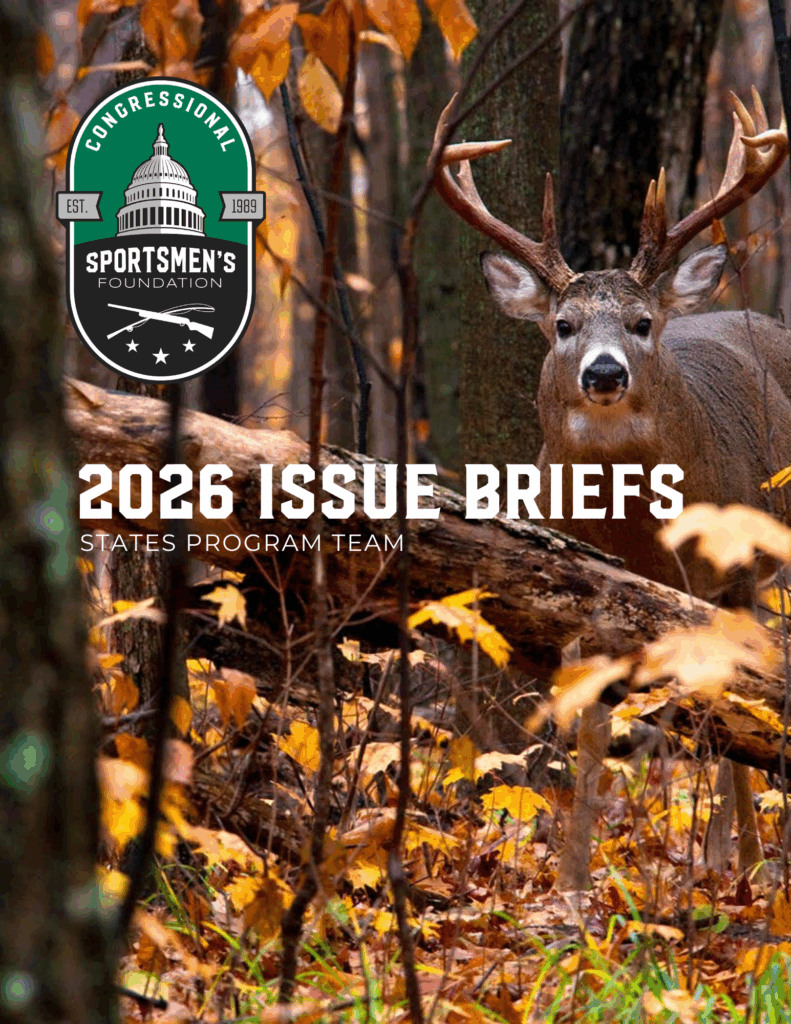 Why It Matters: The breadth of policy issues that impact sportsmen and women and the species they pursue can be overwhelming, but each year the Congressional Sportsmen’s Foundation (CSF) undertakes a thorough process to update and expand its Collection of Issue Briefs – ensuring that legislators, state fish and wildlife agency officials, and partners are apprised of sporting-conservation policy trends across the country.
Highlights:
- The 2026 State Issue Brief Collection is the comprehensive authority for understanding policy topics that impact the woods, waters, and fields across the country.
- The Collection summarizes complex issues, highlights positive and negative legislative trends, provides examples of legislative language, and offers next steps for legislators who wish to pursue or defend against specific issues.
- The Congressional Sportsmen’s Foundation leverages these Issue Briefs to inform proactive conversations with the more than 2,250 state sportsmen-legislators that comprise the National Assembly of Sportsmen’s Caucuses (NASC) network.
Each year, CSF conducts a thorough review of the policy issues that impact hunters, anglers, recreational shooters, and trappers. Just shy of one hundred individual issues, the Collection is organized into four categories: Access & Opportunity, Conservation, Promoting and Protecting Sportsmen’s Heritage, and Youth Engagement & R3. CSF’s States Program Team has spent recent months updating each brief to reflect new legislative or regulatory initiatives, updated data, or new considerations that emerged during the 2025 legislative session.
In addition to refining and updating existing briefs, CSF worked closely with the NASC Executive Council to identify emerging topics that merited inclusion in the 2026 Collection and beyond. From this process, several new briefs were added this year, including discussions on the role of prescribed fire in active forest management, the importance of protecting the privacy of sportsmen and women from merchant category codes, and the considerations surrounding the use of drones to recover game. Each new brief addresses a timely issue that is likely to shape policy debates in the coming years.
Heading into 2026 with CSF’s State Issue Brief Collection in hand, legislators are equipped with an accurate assessment of the sporting-conservation landscape. The Collection provides essential context on trends, statistics, policy language, and perspectives needed to craft informed, effective legislation that safeguards the interests of sportsmen and women, our fish and wildlife resources, and their habitats.
The full 2026 State Issue Brief Collection can be found here.
NASC EXECUTIVE COUNCIL MEMBERS ISSUE RESOLUTION SUPPORTING CONSERVATION EASEMENTS
Article Contact: Kent Keene
Why It Matters: Voluntary conservation easements represent an important opportunity to promote wildlife conservation practices on private land while protecting that land from future development. Recently, efforts designed to eliminate the availability of perpetual conservation easements have emerged, posing a significant threat to easement programs and the benefits they provide to participating landowners and our shared wildlife resources. Recognizing this, 12 bipartisan members of the National Assembly of Sportsmen’s Caucuses (NASC) Executive Council (EC) prepared and adopted a resolution in support of conservation easements and their benefits.
Highlights:
- Voluntary conservation easements on private property can provide landowners with financial benefits, technical assistance, and long-term assurances that their property will remain in a desired state while providing important wildlife habitat, often in perpetuity.
- Recently, efforts to eliminate perpetual easements or require them to be term-limited have increased, posing a significant threat to easement programs and the benefits they provide to both landowners and wildlife.
- In response to the increase in anti-easement rhetoric, 12 members of the National Assembly of Sportsmen’s Caucuses Executive Council issued a resolution highlighting their support for voluntary conservation easements and their associated benefits for landowners, wildlife, and sportsmen and women.
Conservation easements represent one of the most attractive options for landowners who value wildlife conservation and worry about future development on their private property. Easement programs provide landowners with the opportunity to sell or donate (or a combination of the two) the development rights to another party, often a land trust, in exchange for the value of the easement, federal and/or state tax benefits, or both. From there, they agree to maintain certain characteristics on their property (e.g., relatively natural habitat or open space), including assuring that their property will not be developed or subdivided, as defined in the deed of conservation easement, during the term of the easement, many of which are perpetual or permanent.
Recently, some have viewed conservation easements as a negative for future landowners, citing the land use limitations created by easements as a violation of the next owners’ property rights. While easements do limit future land use changes based on the terms of the easement contract, most within the sporting-conservation community tout the conservation value of easements while pointing out that most other land use decisions by current owners are undertaken without regard for future landowners. Instead, easements are a transaction where, rather than selling the entire property (which they could rightfully do), they are selling and/or donating certain uses to another party in the same way mineral rights, water rights, farming rights, timber, access rights for hunting or fishing, and other rights are sold or leased to third parties in some parts of the country.
In an effort to demonstrate support for conservation easements among state legislators, 12 bipartisan members of the National Assembly of Sportsmen’s Caucuses Executive Council recently signed onto a resolution that has since been shared around the community. This resolution highlights many of the conservation benefits associated with easement programs and clearly states the support that each signing member has for this important conservation tool.
Moving forward, the Congressional Sportsmen’s Foundation (CSF) and many of our partners are prepared to act in support of voluntary conservation easement programs while striking a balance between protecting private property rights and promoting conservation enhancements that support wildlife and sportsmen and women.
REMOVAL OF PENNSYLVANIA GAME COMMISSION’S PURCHASING CAP HEADS TO THE SENATE
Article Contact: Kaleigh Leager
Why It Matters: The Pennsylvania Game Commission (PGC) is the Keystone State’s wildlife conservation experts and is entirely funded by sportsmen and women-generated dollars. Currently, the PGC has a purchasing cap of $400/acre for land, which in 2025, is extremely hard to come by – especially in more urban areas. House Bill 1811 seeks to remove the purchasing cap, thus allowing the PGC to potentially purchase lands in more urbanized areas (which have the least amount of access to state game lands), which would ultimately increase access and opportunity for hunting, trapping, and recreational shooting, close to population centers, thus assisting in the recruitment, retention, and reactivation (R3) of sportsmen and women.
Highlights:
- House Bill 1811 (HB 1811) is sponsored by Pennsylvania Legislative Sportsmen’s Caucus Member, Rep. Mandy Steele.
- HB 1811 removes the current $400/acre purchasing cap from the PGC for counties in the first through fifth classes.
- In October of 2025, the Congressional Sportsmen’s Foundation (CSF) submitted a letter of support to the House of Representatives leadership in support of removing the purchasing cap.
- On November 18th, 2025, the House of Representatives sent HB 1811 to the Senate in a 167-35 vote.
The PGC is charged with conserving, managing, and protecting state game lands (which includes shooting/archery ranges) that are filled with wildlife and other natural resources. Hunters, trappers, recreational shooters and archers, along with other outdoor recreation enthusiasts rely on these managed lands to enjoy their treasured past times. However, currently, the PGC has a purchasing cap that is acting as a barrier for purchasing land in areas with higher land costs, keeping most game lands away from these higher population areas.
A lack of access is regularly cited as the number one reason that lapsed hunters give when asked why they decided to stop hunting. The passage of HB 1811 would likely contribute to the recruitment, retention, and reactivation of sportsmen and women in the Commonwealth by allowing the PGC to purchase lands in more populated areas (first through fifth counties) where land valuations can surpass the PGC’s current purchasing cap of $400/acre. Providing more access for sportsmen and women in these more populated areas will likely increase participation, and license sales by extension, and will also have a positive impact on the state’s economy while strengthening the Keystone State’s outdoor heritage. In her legislative memo for HB 1811, Rep. Mandy Steele stated, “…in an effort to conserve land for public access and to protect vulnerable habitats, I will be introducing legislation that would allow the PGC to acquire land at a fair and reasonable price in counties of the first through fifth classes. However, the $400 price per acre cap would remain in place for counties of the sixth through eighth classes. The PGC not only serves our sportsmen and women, but it also serves as a steward of our shared environment and natural resources, providing Pennsylvanians with access to green spaces close to their homes…”
CSF looks forward to working with the Pennsylvania Legislative Sportsmen’s Caucus and the Senate to see HB 1811 across the finish line to remove the antiquated purchasing cap that has hampered the PGC for many years.
States Involved: PA
NEW MEXICO SENATE BILL 5: LEVERAGING PAST SUCCESS FOR FUTURE MOMENTUM
Article Contact: Nate Serlin
Why It Matters: State fish and wildlife agencies are the fundamental entities that secure our sporting heritage. They are where state and federal tax dollars and regulations, biologists, outdoor recreationists, and conservation ideals come together to manage our wildlife and wild places for everyone to enjoy. Having a well-funded, and organized, fish and wildlife agency and commission that preserves the North American Model of Conservation is important to ensuring access and opportunity for sportsmen and women.
Highlights:
- During the 2025 New Mexico Legislative Session, a broad coalition of sporting and conservation groups, including the Congressional Sportsmen’s Foundation (CSF), worked together to pass Senate Bill 5 (NM SB 5), which instituted sweeping reforms to the New Mexico Department of Fish and Game (NMDFG).
- This bill, sponsored by Representative Nathan Small, a New Mexico Sportsmen’s Caucus (NMSC) co-chair, addressed several challenges the NMDFG was facing, including serious underfunding, politicization of the Fish and Game Commission, and lack of independence and authority.
- As we approach the 2026 short budget session, CSF looks toward the horizon to build momentum from SB 5 and the 2025 session to educate legislators and pass more legislation that benefits the sporting community.
The New Mexico Department of Fish and Game faced a crisis as the 2025 legislative session began. They were severely underfunded, to the point that there were serious questions about if they could make payroll. Failure to do so would have created immediate and devastating effects across New Mexico for both wildlife and outdoor recreationists.
NM SB 5 was sponsored by NMSC co-chair Representative Nathan Small and supported by NMSC members on both sides of the aisle. It raised license prices modestly for the first time in over 20 years, without placing an unnecessary financial burden on consumptive recreators. For example, a resident fishing license went from $25 to $35, and sportsmen and women were overwhelmingly supportive of the increase as part of the solution NMDFG funding crisis. The Department’s budget at the time was entirely reliant on dollars raised from recreational license sales and other sportsmen’s funding mechanisms like Pittman-Robertsen and Dingell-Johnson. NM SB 5 updated state statute to allow the legislature to help fund the department, which resulted in a $10.5 million investment from the Government Results and Opportunity (GRO) fund. This left sportsmen without the burden of footing the entire bill to fund NMDFG.
Additionally, the agency lacked the statutory authority to make decisions regarding all wildlife, leaving NMDFG without the tools to manage important plants and animals in the state’s ecosystem. NM SB 5 corrected this by updating the Department’s statutory mission, establishing legislative intent, and delegating management authority for all wildlife to NMDFG, among many other department-related reforms.
The Fish and Wildlife Commission had also become a polarizing and politicized entity that was disjointed and insulated from the input of legislators and the public at large. This bill addressed these concerns by implementing a myriad of checks of balances, including ensuring legislative input on Commission appointees, establishing qualifications for experience and expertise, and making sure no Commissioner could be removed without proper cause.
CSF worked with a wide variety of partners in New Mexico to ensure NM SB 5’s passage with bipartisan support. Jesse Duebel of New Mexico Wildlife Federation was one such partner who helped spearhead the effort to get this necessary reform passed. “SB5, The Wildlife Heritage Act, is the most transformational piece of legislation with regard to wildlife conservation that has passed in New Mexico in my lifetime,” said Jesse. “From bumblebees to bighorn sheep, our state wildlife agency is tasked with ensuring that we have robust populations of wildlife for future generations to enjoy. Because of the success accomplished by the broadest conservation coalition ever compiled, the new Department of Wildlife has both the authority and the resources it needs to apply a 21st century approach to wildlife management in the fourth most biodiverse state in the nation.”
As we approach the 2026 New Mexico Legislative Session, CSF will continue to work with partners and legislative sportsman’s caucus members to build off the historic win of NM SB 5 and put more good legislation on the books for hunters, anglers, recreational shooters, and trappers as we continue to educate the general public and elected officials about the issues at the core of our mission.
States Involved: NM
22ND ANNUAL NASC SPORTSMAN-LEGISLATOR SUMMIT UNITES THE SPORTING-CONSERVATION COMMUNITY BEHIND PROACTIVE POLICY INITIATIVES
(December 15, 2025) – Memphis, Tennessee – Last week, the Congressional Sportsmen’s Foundation (CSF) hosted the 22nd Annual NASC Sportsman‑Legislator Summit in Memphis, Tennessee. Co-hosted by the Tennessee Legislative Sportsmen’s Caucus and the Mississippi Legislative Sportsmen’s Caucus, and presented by CSF and Ducks Unlimited, this year’s NASC Summit took place at the Guest House at Graceland – the Home of Elvis Presley.
The NASC Sportsman-Legislator Summit is the premier annual gathering for state legislative sportsmen’s caucus members and partners from across the country. It serves as the leading forum for focused discussion, collaboration, and the development of strategies to protect and advance the interests of America’s sportsmen and women in state legislatures.
Held under the theme “Temperature Rising: Turning Up the Heat Through Proactive Sporting-Conservation Policy Initiatives,” the 2025 Summit brought together over 320 attendees, including 85 legislators from 25 states, state and federal agency leaders, conservation organizations, and outdoor industry professionals. This year’s event emphasized proactive policymaking to meet modern conservation challenges and ensure the future of America’s time-honored outdoor traditions.
“This year’s Summit theme captures the momentum we’re building through this event. We’re no longer waiting for challenges to come to us; we’re working together to shape the future of conservation and ensure the next generation inherits the same opportunities to hunt, fish, and enjoy the outdoors that we cherish today,” said Brent Miller, Vice President, Policy at the Congressional Sportsmen’s Foundation. “The success of this Summit truly reflects the power of partnership between legislators, conservationists, and industry leaders. By working across state lines and political boundaries, we’re advancing the policies that strengthen wildlife, habitat, and the outdoor traditions that unite us all.”
Topics covered at this year’s event included, but were not limited to, achieving legislative results through proactive policy initiatives, investing in our public lands, the role of hunters in society, and so much more. In addition to educational sessions, regional breakouts, and Executive Council meetings, the Summit also featured group demonstrations, an auction and raffle, outdoor sporting activities, and an awards ceremony.
During the awards ceremony, CSF’s States Program Team recognized individual legislators and groups for their outstanding contributions to advancing conservation policy and furthering the mission of the NASC network. This year’s award recipients included:
- NASC Regional Heritage Award
-
- Northeast – Representative Mandy Steele (Pennsylvania)
- Southeast – Representative Chas Cannon (Georgia)
- Midwest – Senator Jon Bumstead (Michigan)
- West – Representative Paul Fielder (Montana)
- Friends of NASC Awards
- Ducks Unlimited
- Bass Pro Shops
- State Agency of the Year
- Louisiana Department of Wildlife & Fisheries
- State Caucus Partner of the Year
- Friends of Connecticut Sportsmen
- Outgoing EC Member Awards
-
- Representative Bobby Cox (South Carolina)
- Sportsmen’s Caucus Advisory Council of the Year
-
- Montana
CSF would like to thank all the sponsors who made the 22nd Annual NASC Sportsman-Legislator Summit possible including Presenting Sponsor: Ducks Unlimited. Title Sponsors: Bass Pro Shops; Cabela’s; Capital One; National Shooting Sports Foundation; Outdoor Sportsman Group; Richard Childress Racing; Safari Club International; and The Kinetic Group. Host Sponsors: Delta Waterfowl; and Range USA.
CONGRESSIONAL SPORTSMEN’S FOUNDATION INTRODUCES THE 2026 NASC EXECUTIVE COUNCIL
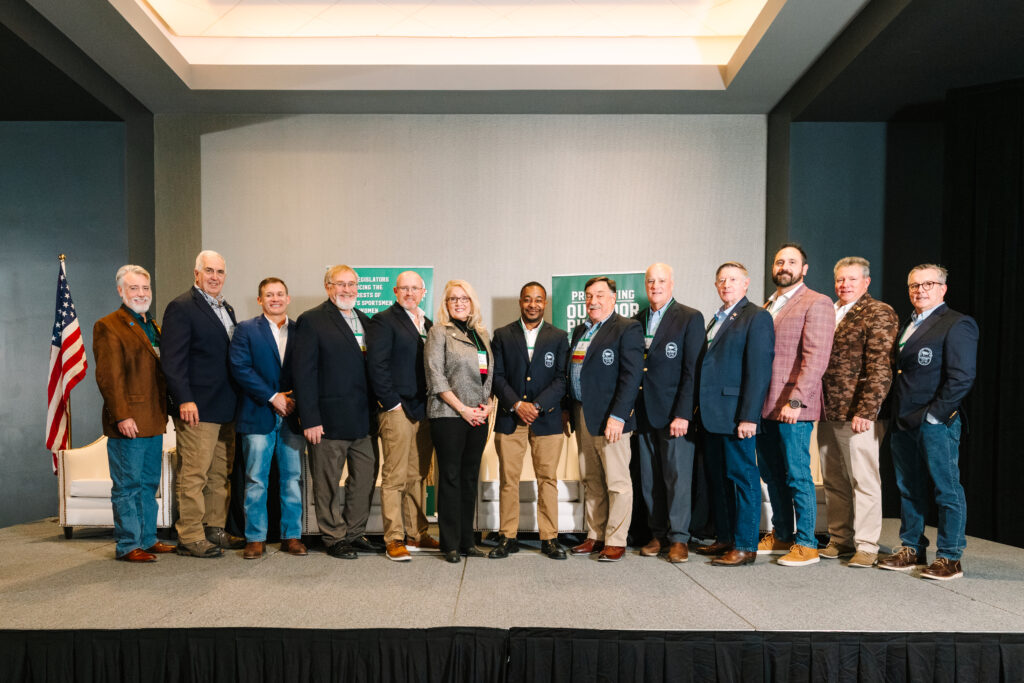 (December 18, 2025) – Washington, D.C. – With state legislative sessions for 2026 on the horizon, the Congressional Sportsmen’s Foundation (CSF) has revealed the slate of state legislators who will serve as an advisory entity for CSF staff in their administration of the National Assembly of Sportsmen’s Caucuses (NASC) in the coming year through their election to the NASC Executive Council. The National Assembly of Sportsmen’s Caucuses is a key component of CSF’s network of caucuses and brings together state lawmakers dedicated to advancing and protecting sportsmen’s interests across the country.
Since its founding in 2004, NASC has grown into the nation’s leading pro-conservation state policy network, helping secure well over a thousand legislative victories at the state level in just the last five years alone on behalf of sportsmen and women. Today, more than 2,250 state legislators from all 50 states participate in their respective legislative sportsmen’s caucuses, united through NASC’s mission and collaborative framework.
The 2026 NASC Executive Council is as follows:
Leadership
- President: Representative Jeff Wardlaw (AR)
- Vice President: Senator Pat Brennan (VT)
- Secretary: Senator Jack Bailey (MD)
Members
- Representative Nick Archer (OK)
- Representative C. Scott Bounds (MS)
- Representative Jesse Chism (TN)
- Representative Paul Fielder (MT)
- Representative Jerome Zeringue (LA)
- Senator Robin Webb (KY)
- Representative Chas Cannon (GA)
- Representative Amos O’Neal (MI)
- Representative Steve Wood (ME)
Alternate Members
- Senator Russell Ott (SC)
- Representative Bruce Sassmann (MO)
- Representative James Spillane (NH)
“Hunting, angling, and outdoor recreation remain fundamental to our heritage and our conservation success,” said NASC Executive Council President Jeff Wardlaw. “Serving on the Executive Council is a privilege, and in 2026, we intend to continue to build upon more than two decades of momentum. NASC has evolved from a pioneering idea into the most effective policy network of its kind, and we will continue working to conserve our natural resources while protecting America’s sporting traditions.”
The Executive Council, elected by NASC members at the Annual NASC Sportsman-Legislator Summit, provides advice to the Congressional Sportsmen’s Foundation and ensures that NASC continues to deliver exceptional support to state legislative sportsmen’s caucuses. The Council helps shape NASC activities, develops issue briefs, and recommends standards to strengthen affiliated caucuses across the country.
“As we look ahead to 2026, our focus is on utilizing the strength of the NASC network to secure meaningful, proactive policy outcomes for America’s sportsmen and women,” said CSF Vice President, Policy, Brent Miller. “The Executive Council is instrumental in helping CSF protect and advance our conservation legacy. We deeply appreciate their commitment, partnership, and service.”
For more information about the National Assembly of Sportsmen’s Caucuses and the Executive Council, click here.
SHARE ON

You may also like

The role corn plays for gamebirds and economies ac...
Sportsmen’s conservation policy issues from publ...
Sportsmen’s conservation policy issues from publ...